
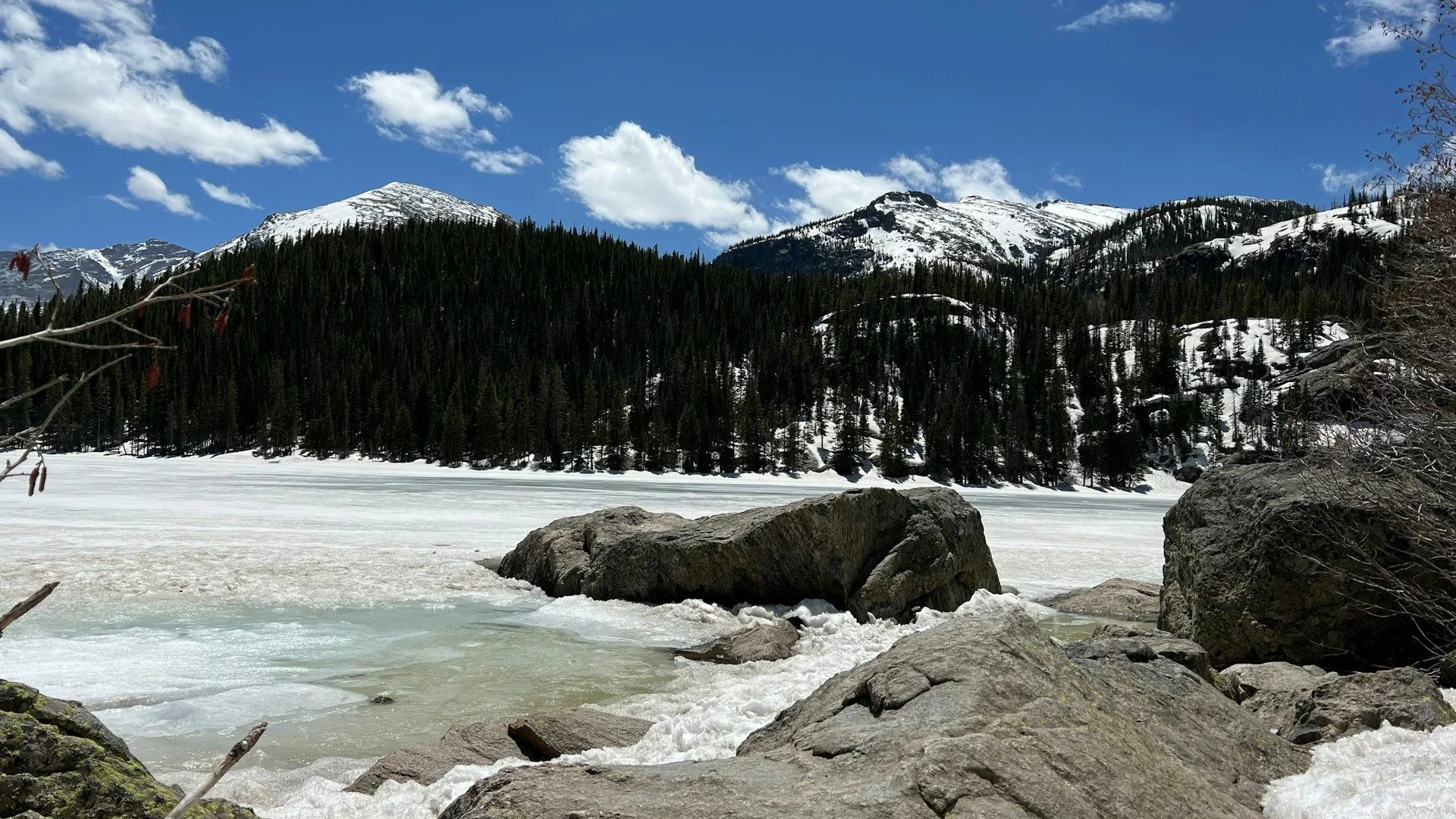
If you’re planning snowshoeing Rocky Mountain National Park this January, you’ll need more than just snowshoes and enthusiasm. Trail conditions in RMNP vary dramatically with elevation, recent weather, and foot traffic patterns. This guide shares my experience navigating these variables during a mid-January trip to Emerald Lake.
Scope: This guide focuses specifically on snowshoeing trails accessible from the Bear Lake Corridor in Rocky Mountain National Park during January. It does NOT cover the Wild Basin area, Longs Peak trailhead routes, or west side trails near Grand Lake.
Quick Decision Summary (January 2026)
- Best conditions for snowshoeing Rocky Mountain National Park: 8-10+ inches base snow, temperatures 15-30°F, clear or partly cloudy skies, wind under 20 mph
- When to skip this trip: During or within 48 hours after major storms (avalanche risk elevated), wind speeds exceeding 30 mph (dangerous on exposed ridges), holiday weekends without arriving before 7:00 AM
- Who this is for: Intermediate snowshoers comfortable with 3-5 mile outings and 500-800 ft elevation gain, those with prior hiking experience at altitude
- Better alternatives if: You want a beginner-friendly first experience (try Sprague Lake Loop instead), you want solitude (try Cub Lake or Upper Beaver Meadows), you want extreme challenge (wait for stable conditions and attempt Sky Pond)
Winter 2025-2026 Conditions Update
This January has brought above-average snowfall to Rocky Mountain National Park, creating excellent snowshoeing conditions:
- Bear Lake Corridor trails currently have 12-18 inches of snow base above 9,500 feet
- Trails around Bear Lake and Glacier Gorge are icy in spots – microspikes recommended alongside snowshoes
- Compared to January 2025: More consistent snow coverage this year, but also more ice on packed trails due to freeze-thaw cycles
Why I Chose Emerald Lake Over Other RMNP Snowshoe Trails
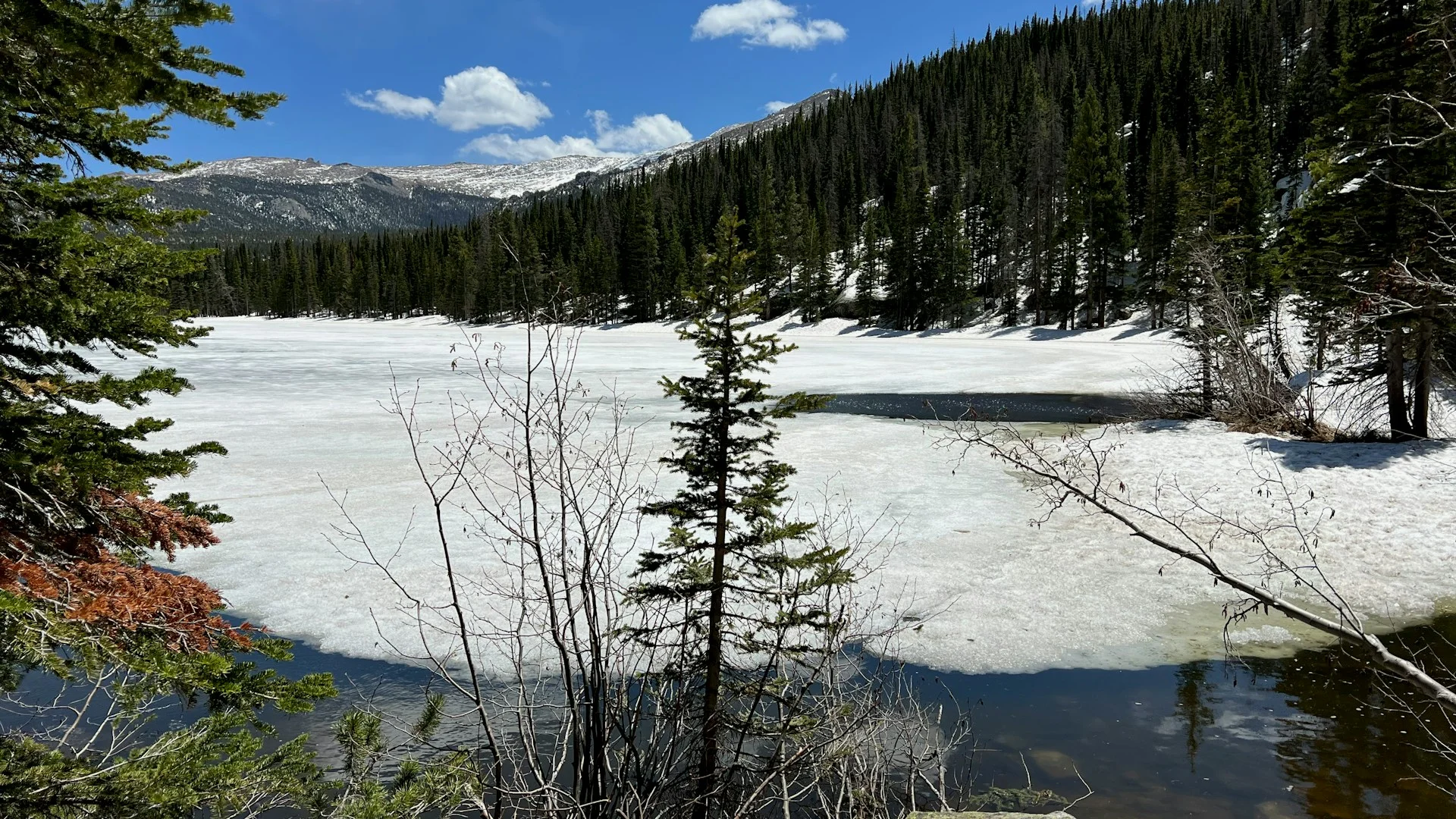
When planning my mid-January snowshoe trip, I spent considerable time weighing options. Here is the decision logic that led me to Emerald Lake via Dream Lake:
Compared to Bear Lake Loop: Bear Lake is under 1 mile with minimal elevation gain. Perfect for beginners testing gear, but I wanted something that would take 2-3 hours and feel like a real winter adventure. Bear Lake is a warm-up, not a destination for intermediate snowshoers.
Compared to Lake Haiyaha: Haiyaha sits at similar distance (3.9 miles) but involves more technical terrain with boulder fields that become hazardous under snow. Multiple trip reports warned that route-finding to Haiyaha in winter requires experience, and the final approach can be treacherous when icy. I flagged it as a “next year” objective.
Compared to The Loch: At 5.7 miles round trip with 1,000 feet of gain, The Loch pushes into full-day territory when accounting for 30-50% slower snowshoe pace. My group had 4 hours maximum, making it too ambitious.
My choice logic: Emerald Lake hit the sweet spot – 3.4 miles round trip, 718 feet elevation gain, achievable in 2.5-4 hours on snowshoes, with the bonus of passing through both Nymph Lake and Dream Lake along the way. According to AllTrails, Emerald Lake Trail maintains a 4.8-star rating from over 25,000 reviews, and the scenic payoff is substantial.
The Journey: Bear Lake to Emerald Lake in January
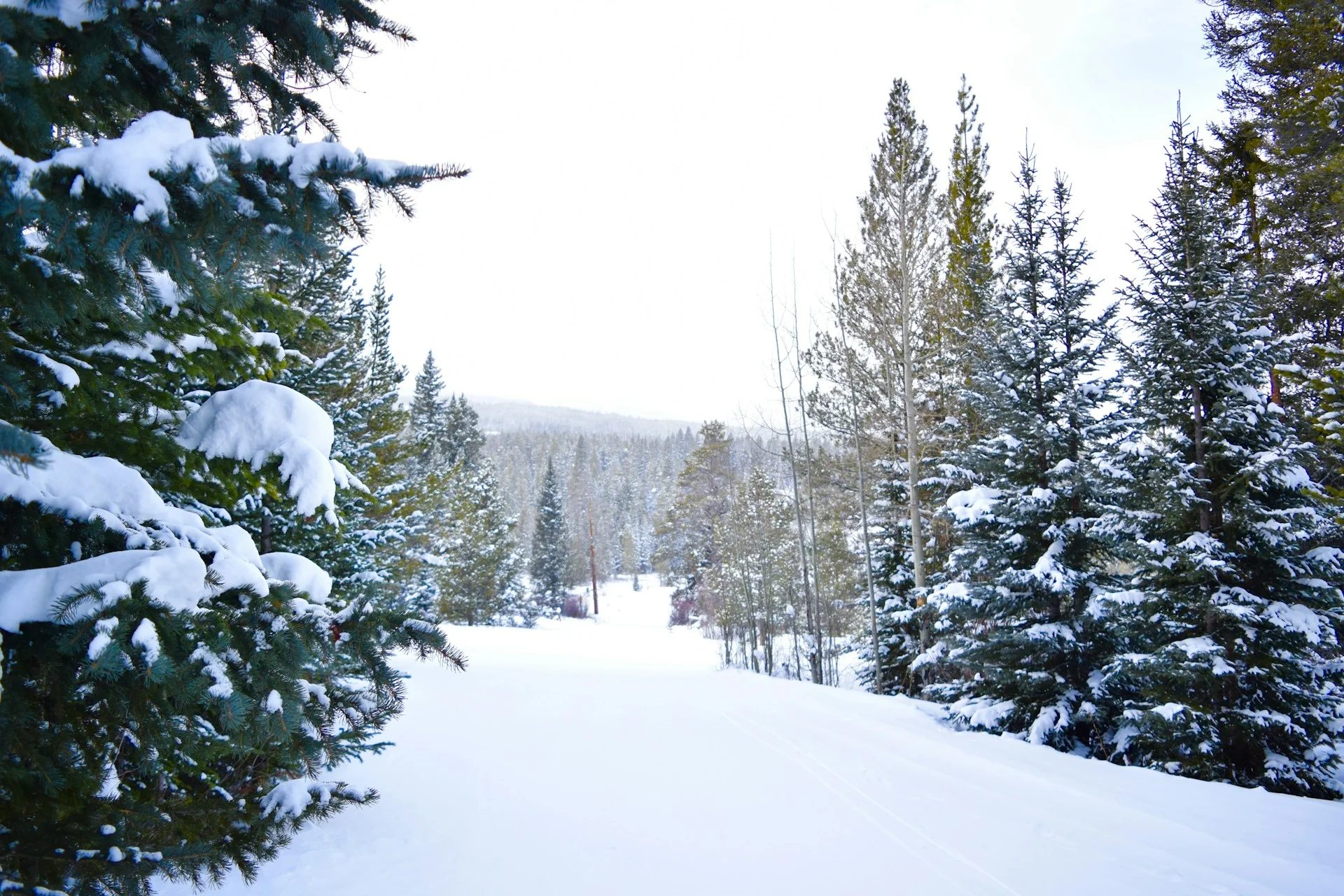
We arrived at Bear Lake parking area at 6:45 AM on a Thursday – a deliberate choice. According to local sources, the lot fills by 7:30 AM on weekends, and weekday visits see roughly 50% fewer visitors. Even on this Thursday in mid-January, a dozen cars were already there.
The temperature at the trailhead read 18°F with calm winds. Perfect. I strapped on my snowshoes immediately – the snow depth exceeded 2 inches within the first hundred yards, exactly the threshold where snowshoes become more efficient than microspikes.
The first 0.5 miles to Nymph Lake served as our warmup. The trail climbs steadily through lodgepole pine forest, and I could feel my body adjusting to the altitude. Bear Lake sits at roughly 9,475 feet, and by Emerald Lake we would reach approximately 10,100 feet. I reminded myself to pace slower than my summer hiking rhythm.
Nymph Lake appeared frozen solid, the lily pads that give it its name long buried under snow and ice. We paused briefly, then continued toward Dream Lake.
The Dream Lake stretch is where the magic happens. The trail gains elevation through a stunning corridor of snow-laden evergreens, with Hallett Peak gradually revealing itself through the trees. At 1 mile from the trailhead, Dream Lake opened before us – a classic postcard scene with the peak’s distinctive flat summit looming above the frozen lake.
Here I made a judgment call. Wind had picked up to roughly 15 mph, and clouds were building over the Continental Divide. My original plan included extending to Lake Haiyaha if conditions allowed, but the weather window seemed to be narrowing. We committed to Emerald Lake and turned back on the way out.
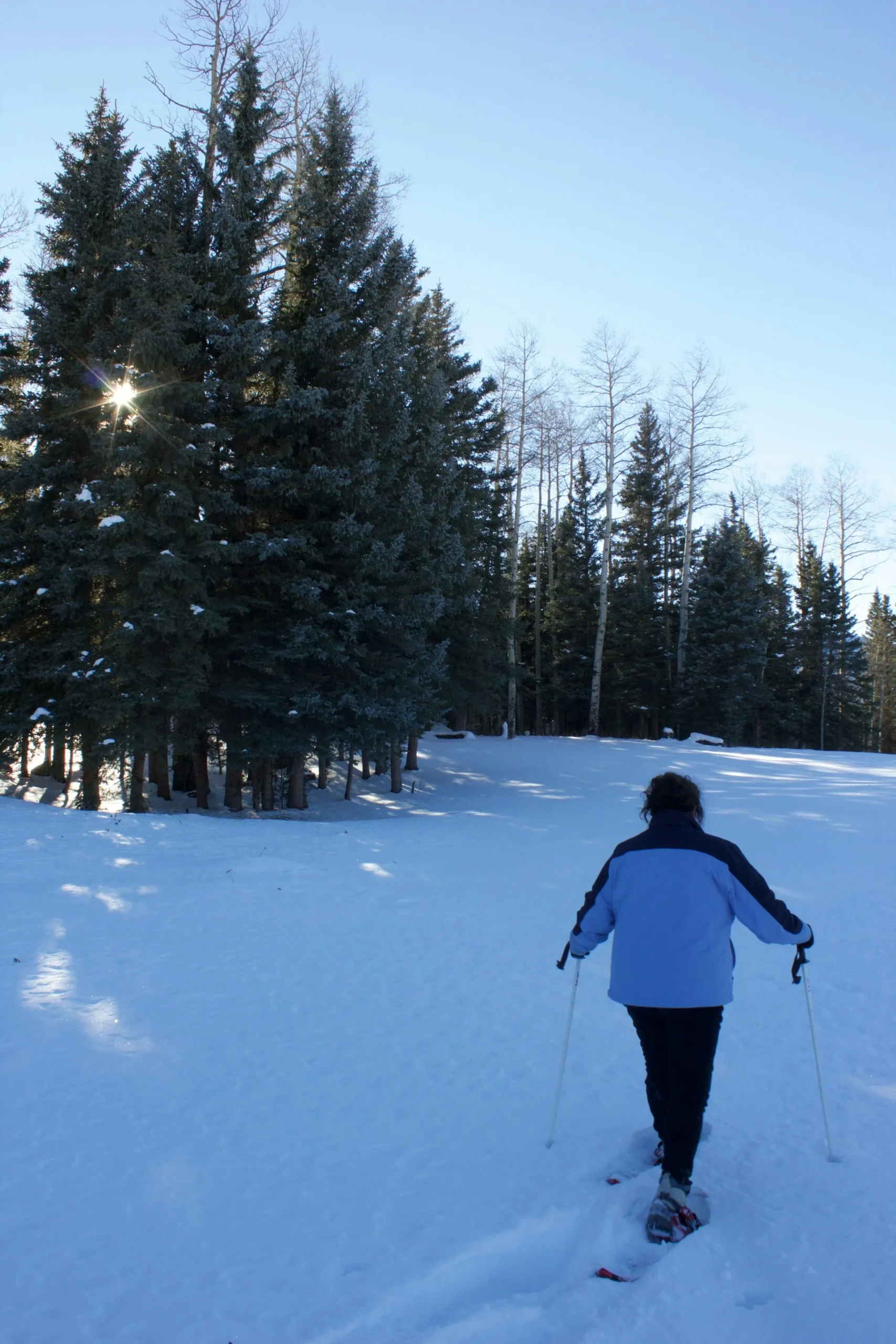
The final 0.6 miles to Emerald Lake traverses more exposed terrain. This is where microspikes would have been useful – sections of the trail had been packed into ice by previous hikers, and my snowshoes occasionally slipped on the hardpack. I found myself wishing I had brought both.
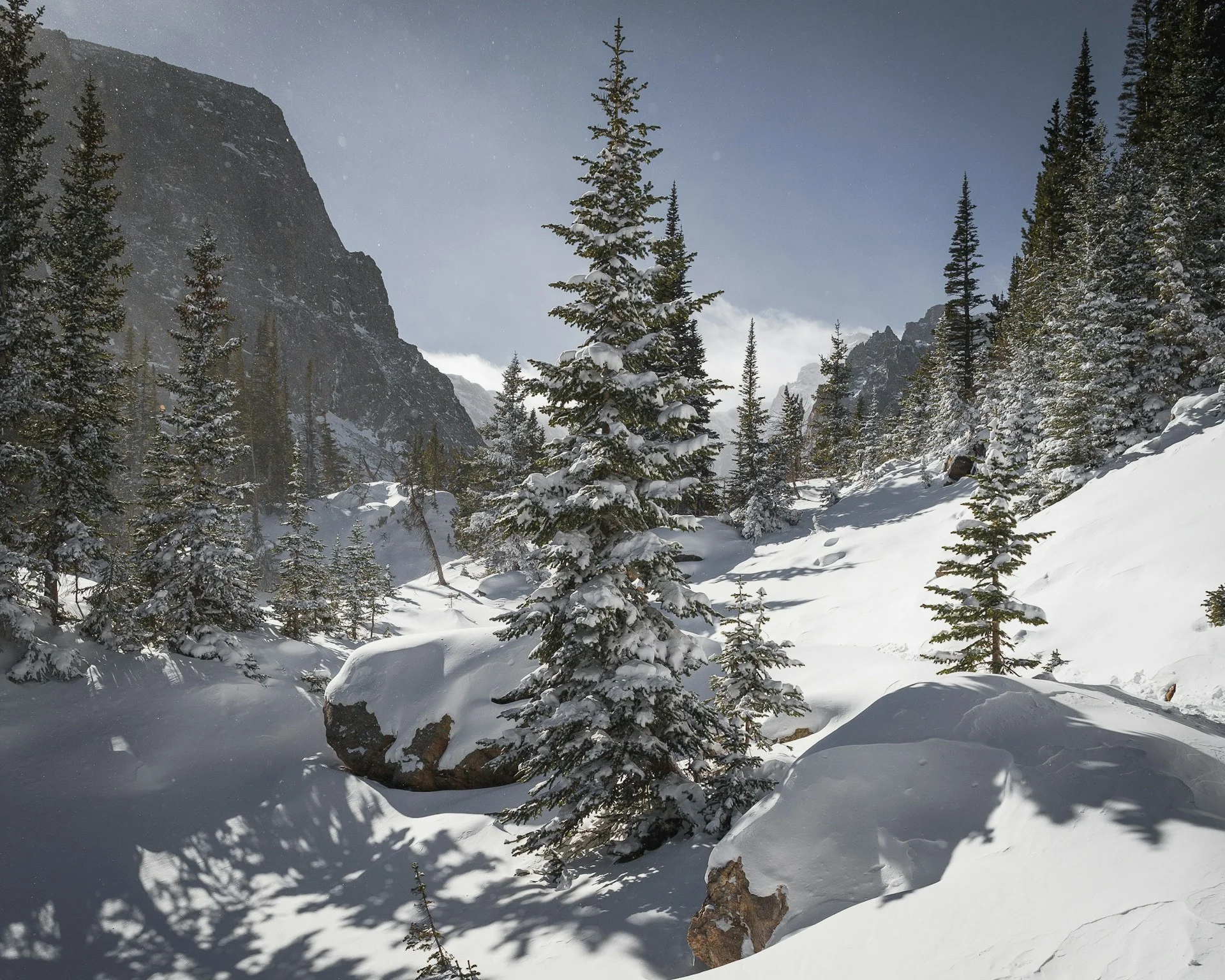
Emerald Lake sits in a dramatic cirque, surrounded by Hallett Peak, Flattop Mountain, and the profile of Tyndall Glacier. In January, the entire scene is monochrome white and gray, with deep blue sky overhead. We arrived at 9:30 AM, spent 20 minutes eating snacks and taking photos, then began our descent.
Total trip time: 3 hours 15 minutes including breaks. This aligns with the 30-50% slower pace that experienced Colorado snowshoers report compared to summer hiking.
Best Snowshoe Trail Selection for Rocky Mountain National Park in January
Not every trail is appropriate for every snowshoer or every day. Here is how I categorize the Bear Lake Corridor options for snowshoeing Rocky Mountain National Park:
When Snow Depth Exceeds 12 Inches (Soft Snow Conditions)
Snowshoes essential. Microspikes alone will leave you postholing.
| Trail | Distance | Elevation | Time on Snowshoes | Best For |
|---|---|---|---|---|
| Bear Lake Loop | 0.7 mi | 49 ft | 30-45 min | Gear testing, families with young kids |
| Nymph Lake | 1.1 mi | 245 ft | 1 hr | Easy half-day, photography |
| Dream Lake | 2 mi | 459 ft | 1.5-2 hrs | Best intermediate destination |
| Emerald Lake | 3.4 mi | 718 ft | 2.5-4 hrs | Full intermediate experience |
When Trail is Packed/Icy (Post-Traffic Conditions)
Microspikes often sufficient on main trails. Bring snowshoes for side exploration.
| Trail | Distance | Elevation | Time with Spikes | Notes |
|---|---|---|---|---|
| Alberta Falls | 1.6 mi | 232 ft | 1-1.5 hrs | Frozen waterfall views, steep sections |
| Sprague Lake Loop | 0.9 mi | 36 ft | 30-45 min | Flat, accessible, wheelchair-friendly in summer |
Not Recommended in January Without Advanced Preparation
These trails carry elevated risk in mid-winter for snowshoeing Rocky Mountain National Park:
| Trail | Why Not in January |
|---|---|
| Sky Pond | 9.9 miles, 2,168 ft gain, requires crossing The Loch and ascending exposed terrain. Wind and blowing snow require ski goggles. |
| Chasm Lake | 8 miles to the base of Longs Peak’s Diamond face. Avalanche terrain, cornices, serious navigation challenges. |
| Flattop Mountain | 8.9 miles, 2,850 ft gain. Above treeline exposure, whiteout risk, no shelter. |
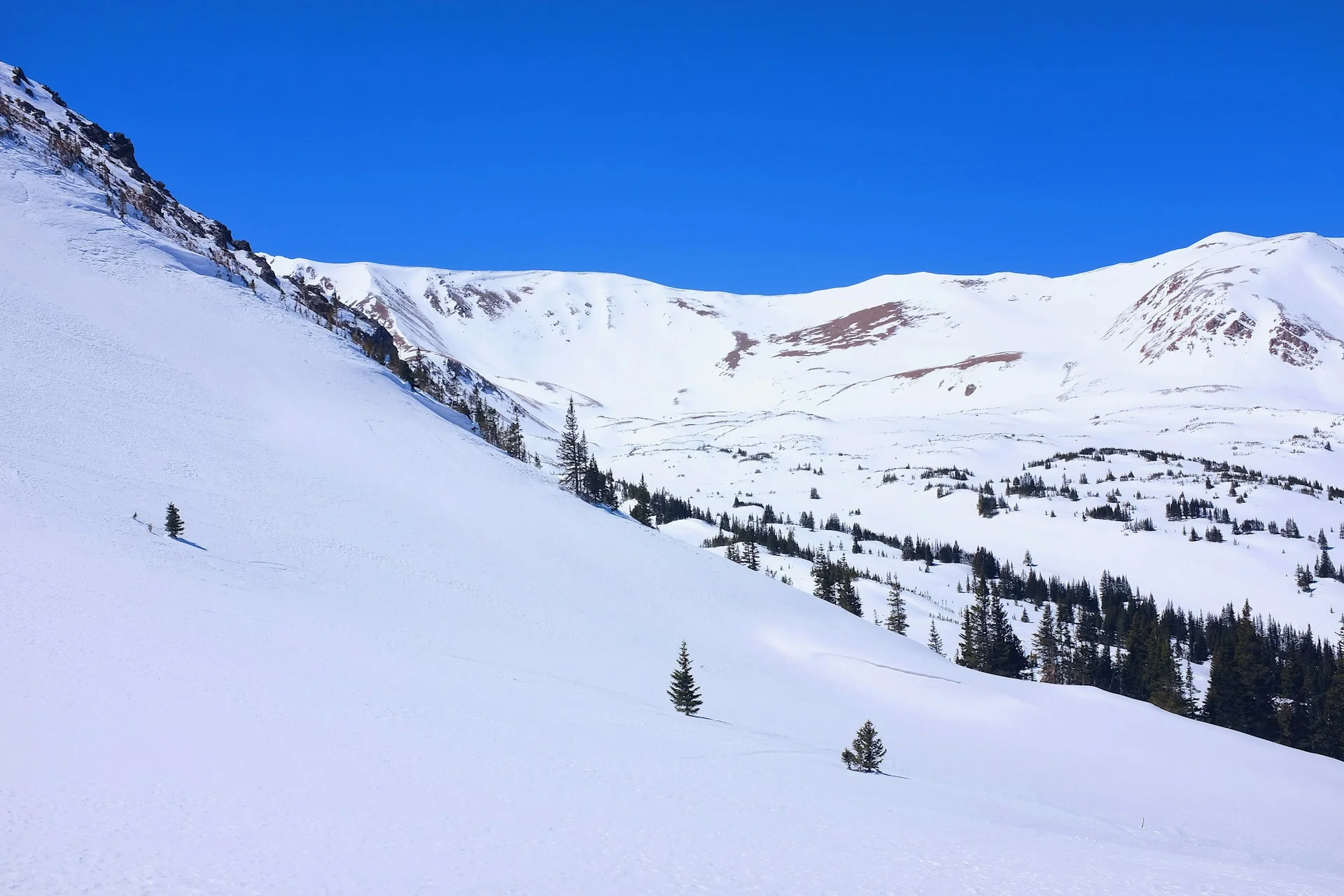
Essential Gear Decisions for RMNP Snowshoeing in Variable Conditions
The NPS advice is simple: “If you can hike, you can snowshoe.” This is true for the physical motion, but gear selection for snowshoeing Rocky Mountain National Park in January requires more nuance.
The Snowshoe vs. Microspike Decision
Through trial and error, I have landed on this rule:
- Use snowshoes when: Snow is soft, feet sink more than 2 inches, you are breaking trail or following partially broken trail
- Use microspikes when: Trail is packed hard, icy sections dominate, speed matters more than flotation
- Bring both when: You are unsure of conditions, attempting longer routes, or visiting mid-week when trails may be less packed
On my Emerald Lake trip, snowshoes were the right call for 80% of the trail. The 20% that was icy hardpack would have been easier with spikes. Next time I will strap microspikes to my pack as backup.
Gaiters Are Not Optional
Even with waterproof boots, snow works its way into the gap between boot and pants. By mile 2, my socks were damp. Gaiters solve this completely. I now consider them mandatory for any RMNP snowshoe outing.
Trekking Poles Transform the Experience
The NPS says poles are “optional.” I disagree for intermediate trails. On the steeper sections between Dream Lake and Emerald Lake, poles provided balance that prevented two near-falls. Most rental shops in Estes Park include poles with snowshoe rentals for $10-20 per day.
Ranger-Led Snowshoe Programs in RMNP
If you prefer guided experiences for snowshoeing Rocky Mountain National Park, Rocky Mountain Conservancy offers ranger-led snowshoe programs from late January through mid-March 2026:
- Kid-friendly walks: Saturdays at 2:00 PM, 1 hour duration (January 24 through March 21)
- Snowshoe hikes: Tuesdays and Thursdays at 12:30 PM, 2 hours, ages 8 and up (starting January 27)
These programs are free but require advance registration that opens 7 days prior at midnight Mountain Time. Maximum 20 participants per session. Critical detail: you must bring your own snowshoes – no rentals are available inside the park.
The programs operate at 9,400-9,700 feet elevation and require a minimum 8-10 inch snow base to proceed.
Challenges and Lessons Learned
Challenge 1: Underestimating descent difficulty
Going down on snowshoes is harder than going up. On the steep section below Dream Lake, I found myself side-stepping rather than walking straight down. My calves burned more on descent than ascent. Lesson: factor in extra time and energy for the return trip.
Challenge 2: No cell service
I knew this intellectually but was still caught off guard when I wanted to check the weather radar. Download offline maps and weather forecasts before entering the park. The NPS recommends carrying a topographic map and compass for any backcountry travel.
Challenge 3: Parking anxiety
Even arriving at 6:45 AM on a Thursday, I felt pressure about the lot filling. On weekends, this stress would multiply. My future strategy: target Tuesday-Wednesday visits, or arrive after 2:00 PM when morning crowds thin out.
What I would do differently next time:
- Bring microspikes strapped to my pack as backup
- Wear gaiters from the start, not halfway through
- Pack an extra 500 calories – cold burns fuel faster
- Download the AllTrails offline map for Dream Lake/Emerald Lake area
- Check Colorado Avalanche Information Center (avalanche.state.co.us) the morning of, not just the night before
Snowshoe Rental and Logistics for RMNP First-Timers
If you do not own snowshoes, Estes Park offers several rental options for exploring Rocky Mountain National Park:
- Estes Park Mountain Shop: Provides free RMNP snowshoe maps and current condition information with rentals
- Kirk’s Mountain Adventures: Offers guided snowshoe tours in addition to rentals
- YMCA of the Rockies: Budget-friendly at $10 adults, $5 children 12 and under
Snowshoes with poles typically rent for $10-20 per day. I recommend calling ahead in January – inventory can run low on busy weekends.
For current trail conditions, contact the park ranger station at 970-586-1206. They can advise on snow depth, ice conditions, and any recent avalanche activity in the Bear Lake Corridor.
Conclusion: Is Snowshoeing Rocky Mountain National Park Worth It?
Snowshoeing Rocky Mountain National Park in January offers a fundamentally different experience than summer hiking. The crowds thin dramatically, the landscape transforms into a white wilderness, and the physical challenge increases just enough to make reaching your destination feel earned.
Emerald Lake proved to be an excellent intermediate objective – challenging enough to feel like an accomplishment, achievable enough to complete in a morning, scenic enough to justify the effort. Dream Lake alone would have been worth the trip.
For those considering their first RMNP winter adventure, I recommend starting with Dream Lake as your destination. If conditions and energy permit, continue to Emerald. If not, Dream Lake delivers 80% of the scenic reward at 60% of the effort.
The mountains will be here next month too. There is no shame in turning around.
Field Decision Notes (January 2026)
- Best timing: Mid-week (Tuesday-Thursday) between 7:00 AM and 2:00 PM. Avoid holiday weekends unless arriving before 7:00 AM.
- Snow depth threshold for snowshoes: When feet sink more than 2 inches in snow, snowshoes become more efficient than microspikes.
- Temperature comfort range: 15-30°F is ideal. Below 10°F, exposed skin risks frostbite within 30 minutes. Above 35°F, snow becomes slushy and snowshoes drag.
- Wind threshold: Cancel or choose sheltered trails (Cub Lake, Alberta Falls) if sustained winds exceed 25 mph. Exposed ridges become dangerous above 30 mph.
- Elevation adjustment: Expect 30-50% slower pace than summer. A 2-hour summer hike becomes 3-hour snowshoe trip.
- Gear decision point: Bring both snowshoes AND microspikes if unsure of conditions. Most trails have mixed surfaces in January.
- Avalanche awareness: Check Colorado Avalanche Information Center before any trip. Avoid slopes steeper than 30 degrees. Most avalanches occur during or within 48 hours after storms, high winds, or thaw periods.
- Common mistakes to avoid: Starting too late (parking fills by 7:30 AM weekends), underestimating water needs (cold suppresses thirst but not dehydration), forgetting sunglasses (snow blindness is real), skipping gaiters (wet feet ruin trips).
- First-timer recommendation: Start with Dream Lake (2 miles round trip, 459 ft gain). If that feels comfortable, extend to Emerald Lake on your next visit.
References
Official Sources:
- Snowshoeing in Rocky Mountain National Park – National Park Service
- Snowshoe with RMNP Programs – Rocky Mountain Conservancy
Trail Data:
- 10 Best Snowshoeing Trails in Rocky Mountain National Park – AllTrails
- The Best Snowshoeing in Rocky Mountain National Park – 10Adventures
Local Resources:
- Current Trail Conditions – Rocky Mountain National Park Guide
- Snowshoe Rentals in Estes Park – Visit Estes Park